Disclosure: This site is reader-supported and may earn a commission from some product links. This article is for information only and is not medical advice.
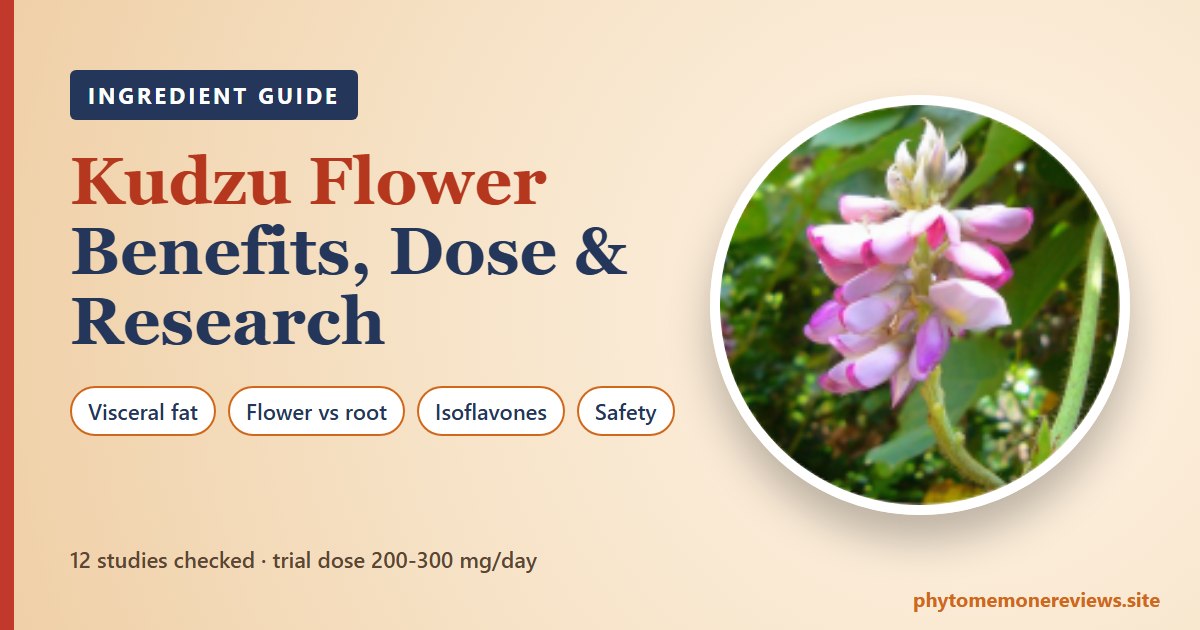
Kudzu flower extract is a popular “belly fat” ingredient in Japan, and it now appears in Western supplements for weight, blood sugar and even memory. It is often confused with kudzu root, the better-known alcohol herb, but the research behind them is different.
We read the published studies on kudzu flower (Pueraria flower, or Puerariae Flos) on PubMed to explain which kudzu flower extract benefits have been shown in people, what is still animal research, what dose was used, and who should avoid it.
Kudzu Flower Extract in Short
Kudzu flower extract is a hot-water extract of the flowers of Pueraria thomsonii or Pueraria lobata. One 12-week Japanese trial in 81 adults with obesity found that 200-300 mg a day lowered BMI and visceral (belly) fat compared with placebo. A small Korean trial of a kudzu flower and mandarin peel blend reduced hot flushes. The strong alcohol-reduction trials used kudzu root products, not the flower. There are no human trials on memory.
What Is Kudzu Flower Extract?
Kudzu is a climbing vine in the pea family, native to East Asia. Traditional medicine uses two parts: the root (Puerariae Radix), mainly for colds and fever, and the purple flower (Puerariae Flos), traditionally used for alcohol intoxication and hangovers. A 2023 review lists 39 flavonoids, 19 saponins and 25 volatile oils found in the flower so far.
The main compounds in the flower are the isoflavones tectoridin and kakkalide. Human gut bacteria turn these into tectorigenin and irisolidone, the forms likely absorbed into the blood. Kudzu root is best known for puerarin instead, so root results cannot simply be applied to flower supplements.
In Japan, kudzu flower isoflavones are sold in “Foods with Function Claims” labelled for reducing visceral fat, and fat-lowering foods have become the flower’s best-known modern use.
Kudzu Flower Extract Benefits: What the Research Says
Human research on the flower is thin. Here are the most relevant studies we found, human trials first.
| Study | Who and what | Main result |
|---|---|---|
| Kamiya et al., 2012 | 81 Japanese adults with BMI 25 or more; 200 mg or 300 mg flower extract a day, or placebo, for 12 weeks | Lower BMI and less visceral fat area; no change in fat under the skin; similar effect in men and women |
| Kim et al., 2020 | 84 women aged 45-60 with hot flushes; 1,150 mg a day of kudzu flower + mandarin peel blend for 12 weeks | Lower hot-flush scores and severity than placebo; improved a bone-loss marker; no hormone changes or serious side effects |
| Yamazaki et al., 2002 | Adults drinking alcohol after taking dried flower extract | No change in blood alcohol or acetaldehyde levels, but faster clearance of acetaldehyde |
| Kamiya et al., 2012 (mice) | Mice on a high-fat diet with 5% flower extract for 14 days | Less weight and body fat, less fatty liver; signs of more fat burning |
| Tousen et al., 2019 (mice) | Mice without ovaries given flower isoflavones at human and 20x human doses for 28 days | No estrogen-like effects and no liver enzyme changes at human doses; no effect on visceral fat or bone |
| Liu et al., 2015 (mice) | Diabetic mice given 50-200 mg/kg flower extract | Better maze performance, blood sugar and blood fats than untreated diabetic mice |
1. Visceral fat and weight
This is the best-supported use, resting mainly on one human trial. In 2012, 81 Japanese men and women with a BMI of 25 or more took 200 mg or 300 mg of Pueraria thomsonii flower extract, or a placebo, every day for 12 weeks. The extract lowered BMI and reduced the visceral fat area (the fat packed around the organs), but not the fat just under the skin. The authors concluded the drop in BMI came from the loss of visceral fat.
However, the trial was run by researchers at Toyo Shinyaku, a Japanese health-food company, and we found no independent repeat on PubMed. The same company’s mouse study found less body fat and fatty liver, but a 2019 study from Japan’s National Institute of Health and Nutrition found flower isoflavones, even at 20 times the human dose, did not reduce visceral fat in mice without ovaries. Promising, but far from settled.
2. Alcohol and hangovers: flower vs root
This is where the two parts are most often mixed up. Several US placebo-controlled trials found that a standardised kudzu root extract reduced how much heavy drinkers drank. In one, 17 young men on the extract for four weeks cut their weekly drinks by 34-57%, with no change in craving. A 2026 trial in 120 adults with alcohol use disorder found that 2 g of kudzu extract, taken on days when binge drinking was expected, reduced binge-drinking days versus placebo. These were not flower trials.
For the flower, a small 2002 Japanese study found that dried flower extract did not change blood alcohol or acetaldehyde levels in drinkers, but did speed up the removal of acetaldehyde, the compound linked to flushing and headache. A 2007 review noted the two parts may act in opposite ways: the flower may help clear acetaldehyde, while the root blocks the enzyme that breaks it down, making root-based “hangover” products a poor choice. Neither is a proven hangover cure.
3. Isoflavones, estrogen-like effects and menopause
Kudzu flower isoflavones can act a little like estrogen. In lab tests, tectorigenin and irisolidone increased the growth of estrogen-sensitive breast cancer cells (MCF-7). This is a lab finding, not a human result, but it is the reason for caution in hormone-sensitive conditions.
At real-life doses the picture looks milder: the 2019 mouse study found no estrogen-like effects at the human dose. The 2020 Korean trial of a kudzu flower and mandarin peel blend reduced hot flushes in menopausal women with no hormone changes, but as a combination, the effect cannot be credited to the flower alone.
4. Memory and brain health
We found no human studies of kudzu flower extract and memory or focus. The closest is a 2015 study in diabetic mice, where flower extract improved water-maze performance, blood sugar and brain oxidative stress; the authors linked the benefit partly to correcting the diabetes. Most other “kudzu brain” research is on root puerarin, also in animals.
Even so, kudzu flower extract appears in some memory supplements. Phytomem One, a once-daily memory formula, lists it as one of its 10 ingredients, alongside saffron, berberine and Ceylon cinnamon, but does not disclose how much it contains. We looked at the whole formula in our Phytomem One review.
Kudzu Flower Extract Dosage: How Much Should You Take?
| Visceral fat trial | 200 mg or 300 mg of Pueraria thomsonii flower extract a day for 12 weeks |
| Menopause trial | 1,150 mg a day of a kudzu flower + mandarin peel blend for 12 weeks |
| Alcohol trials | Used kudzu root extracts, not flower; root doses do not apply to flower products |
| How long | Human trials lasted 12 weeks; longer use has not been studied |
| Standardisation | Look for a stated isoflavone content; many labels give none |
There is no official recommended dose. Follow the label and do not exceed trial amounts. A product that does not state its dose cannot be matched to any tested amount.
Kudzu Flower Extract Side Effects and Safety
The safety data are encouraging but limited. In a 2013 toxicology study (also from Toyo Shinyaku), a single 5 g/kg dose caused no deaths or organ changes in mice, and rats fed up to 5% of their diet as the extract for 90 days (about 3 g/kg a day) showed no harmful changes in blood, urine or organs. The Korean menopause trial reported no serious side effects, and the 2019 mouse study found no effect on liver drug-processing enzymes (CYP1A and CYP3A) at human doses.
But the human trials were small and none lasted beyond 12 weeks, so long-term safety in people is unknown. Flower safety data also should not be assumed to apply to kudzu root products, or the other way round.
Kudzu Flower Extract Pros and Cons
👍 PROS
Human trial: a 12-week placebo-controlled study found less visceral fat.
Low dose: 200-300 mg a day in that trial.
Good animal safety: no harm at high doses in a 90-day rat study.
Long traditional use: used in Chinese medicine for centuries, mainly for alcohol-related complaints.
👎 CONS
One key trial: the fat result has not been independently repeated.
Company-run: the main human and toxicology studies came from one company’s researchers.
No memory evidence: brain claims rest on a single mouse study.
Root confusion: most alcohol research used the root, not the flower.
Kudzu Flower Extract FAQ
Is kudzu flower the same as kudzu root?
No. Both come from the same vine, but the flower is rich in tectoridin and kakkalide, while the root is rich in puerarin. They have different traditional uses and different research.
Does kudzu flower extract help you lose belly fat?
One 12-week trial in 81 Japanese adults with a BMI of 25 or more found that 200-300 mg a day reduced visceral fat and BMI compared with placebo. The effect has not been independently confirmed.
Does kudzu flower help with hangovers?
It is a traditional hangover remedy, and one small study found faster clearance of acetaldehyde after drinking. It did not lower blood alcohol, and it has not been shown to prevent hangovers.
Does kudzu flower extract improve memory?
Not proven. There are no human memory studies. One study in diabetic mice found better maze performance, but that does not show a benefit in people.
Is kudzu flower extract estrogenic?
Its isoflavones showed estrogen-like activity in lab cells, but a mouse study found no estrogenic effects at human doses. People with hormone-sensitive conditions should still ask a doctor first.
Is kudzu flower extract safe?
Animal toxicology studies found no harm at high doses, and human trials of up to 12 weeks reported no serious side effects. Long-term human safety has not been studied.
Scientific References
- Kamiya T, et al. Consumption of Pueraria flower extract reduces body mass index via a decrease in the visceral fat area in obese humans. Biosci Biotechnol Biochem. 2012. PMID 22878195
- Kamiya T, et al. The crude extract from Puerariae flower exerts antiobesity and antifatty liver effects in high-fat diet-induced obese mice. Evid Based Complement Alternat Med. 2012. PMID 22685484
- Takano A, et al. Oral toxicological studies of Pueraria flower extract: acute toxicity in mice and subchronic toxicity in rats. J Food Sci. 2013. PMID 24245900
- Tousen Y, et al. Safety and efficacy assessment of isoflavones from Pueraria (kudzu) flower extract in ovariectomised mice. Int J Mol Sci. 2019. PMID 31212773
- Shin JE, et al. Estrogenic effect of main components kakkalide and tectoridin of Puerariae Flos and their metabolites. Biol Pharm Bull. 2006. PMID 16755017
- Kim JE, et al. Efficacy and safety of kudzu flower-mandarin peel on hot flashes and bone markers in women during the menopausal transition: a randomized controlled trial. Nutrients. 2020. PMID 33105861
- Yamazaki T, et al. Effects of Pueraria thomsonii dried flower extracts on blood ethanol and acetaldehyde levels in humans. Int J Clin Pharmacol Res. 2002. PMID 12395916
- McGregor NR. Pueraria lobata (kudzu root) hangover remedies and acetaldehyde-associated neoplasm risk. Alcohol. 2007. PMID 17980785
- Lukas SE, et al. A standardized kudzu extract (NPI-031) reduces alcohol consumption in nontreatment-seeking male heavy drinkers. Psychopharmacology (Berl). 2013. PMID 23070022
- Santos GM, et al. Targeted use of kudzu for binge drinking among adults with alcohol use disorder: a phase 2b randomized trial. Am J Psychiatry. 2026. PMID 42978081
- Liu ZH, et al. Flos Puerariae extract ameliorates cognitive impairment in streptozotocin-induced diabetic mice. Evid Based Complement Alternat Med. 2015. PMID 26060502
- Chen C, et al. Oriental traditional herbal medicine: Puerariae Flos, a systematic review. J Ethnopharmacol. 2023. PMID 36621660
Medical disclaimer: This article is for information only and is not medical advice. Statements about supplements have not been evaluated by the Food and Drug Administration. Supplements are not intended to diagnose, treat, cure or prevent any disease. Talk to your doctor before taking kudzu flower or kudzu root extract, especially if you take medication, have a hormone-sensitive condition, are pregnant or breastfeeding, or have liver disease.