Disclosure: This site is reader-supported and may earn a commission from some product links. This article is for information only and is not medical advice.
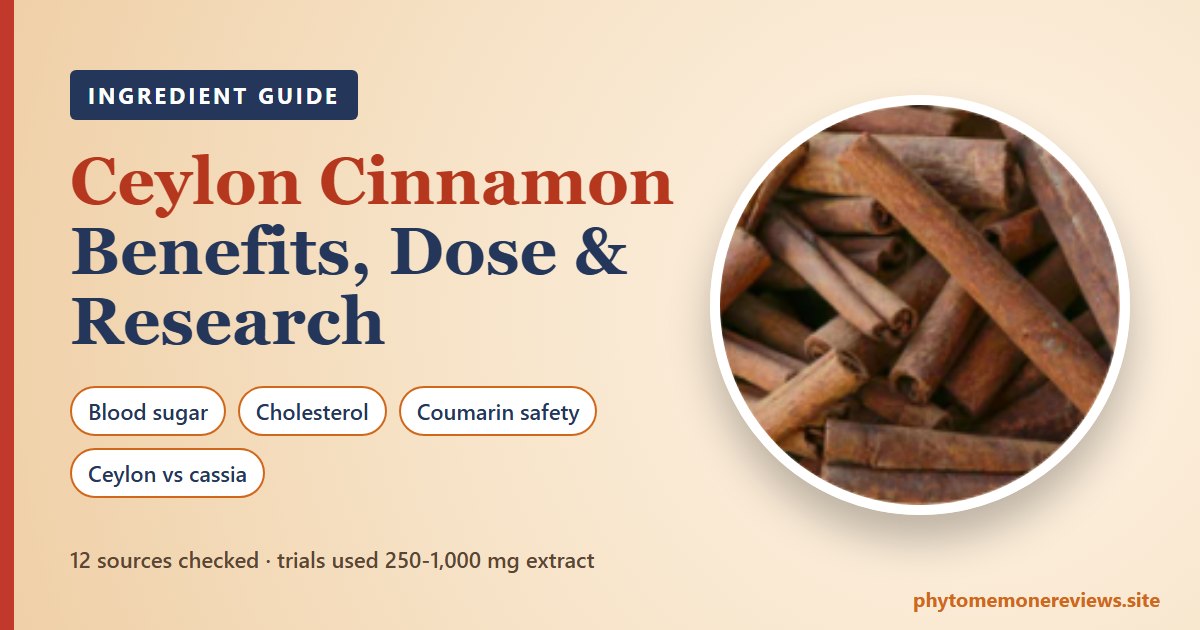
Ceylon cinnamon is often sold as the “true” or “safer” cinnamon, and it now turns up in blood sugar, weight and even brain supplements. But most of the famous cinnamon research was done with a different spice, cassia. So what are the real Ceylon cinnamon benefits, and what is still marketing?
We checked the published research on PubMed, including the Cochrane review, several meta-analyses, the newest Ceylon cinnamon trials from Sri Lanka and the safety data on coumarin. Below we explain how Ceylon differs from cassia, what it may do for blood sugar and cholesterol, what the brain research really shows, how much people take, and who should be careful.
Ceylon Cinnamon in Short
Ceylon cinnamon (Cinnamomum verum, also called C. zeylanicum) is the inner bark of a tree native to Sri Lanka. Its main advantage over cassia is safety: it contains only traces of coumarin, a natural compound that can harm the liver in large amounts. For blood sugar, the research is mixed. The Cochrane review found no clear benefit, while later meta-analyses (mostly of cassia) found modest drops in fasting glucose. Two recent Ceylon-specific trials were encouraging but small and industry-linked. Brain benefits come almost entirely from lab and animal studies.
What Is Ceylon Cinnamon?
Cinnamon is the dried inner bark of trees in the Cinnamomum family. Ceylon cinnamon comes from Cinnamomum verum and is grown mainly in Sri Lanka (once called Ceylon). Its sticks are thin, pale and made of many soft, papery layers, and its taste is milder and sweeter than the cinnamon most people know.
Most cinnamon sold in supermarkets, and in many supplements, is actually cassia: Cinnamomum cassia (Chinese), C. loureiroi (Vietnamese) or C. burmannii (Indonesian). Cassia sticks are thick, hard and darker. The labels usually just say “cinnamon”.
Ceylon vs cassia: why coumarin matters
The biggest practical difference is coumarin. A US study of authenticated bark samples found that C. verum contained only traces of coumarin, while all three cassia species contained substantial amounts. Coumarin was found in every store-bought cinnamon, cinnamon-flavoured food and cinnamon supplement they tested, and most looked like Indonesian cassia. A Sri Lankan analysis put coumarin in Ceylon cinnamon at under 0.01 mg per gram, compared with about 2.23 mg per gram in cassia.
Why does this matter? Coumarin can damage the liver, and some people are much more sensitive to it than others. Germany’s Federal Institute for Risk Assessment (BfR) supports a tolerable daily intake of 0.1 mg per kg of body weight, the same limit set by the European Food Safety Authority. For a 60 kg adult that is 6 mg a day. Using the cassia figure above, that limit could be reached with under 3 grams of cassia a day, and the BfR found that heavy cassia eaters can reach it. Ceylon cinnamon avoids this problem almost entirely, which is why it is the better choice for daily supplement use.
Ceylon Cinnamon Benefits: What the Research Says
Here are the main human studies and reviews we checked. Note which ones used Ceylon cinnamon and which mostly used cassia.
| Study | Who and what | Main result |
|---|---|---|
| Leach & Kumar, 2012 (Cochrane) | 10 trials, 577 people with type 1 or 2 diabetes; mostly cassia, about 2 g/day for 4-16 weeks | No significant effect on HbA1c, insulin or post-meal glucose; fasting glucose effect inconclusive |
| Allen et al., 2013 | Meta-analysis, 10 trials, 543 people with type 2 diabetes; 120 mg to 6 g/day | Lower fasting glucose, total cholesterol, LDL and triglycerides; no significant HbA1c change; very mixed results between trials |
| de Moura et al., 2025 | Meta-analysis, 28 trials, 3,054 people with type 2 diabetes | Fasting glucose about 15 mg/dL lower and HbA1c lower; doses of 2 g/day or less looked best; high variation between trials |
| Wickenberg et al., 2012 | 10 adults with impaired glucose tolerance; 6 g Ceylon cinnamon with a glucose drink | No effect on blood sugar or insulin after the drink |
| Muthukuda et al., 2025 | 150 adults with raised LDL; 1,000 mg/day Ceylon extract or placebo for 12 weeks | LDL not significantly lower than placebo; fasting blood sugar fell more, mainly in people with type 2 diabetes |
| Ranasinghe et al., 2025 | 210 adults with type 2 diabetes; 250 mg or 500 mg Ceylon extract or placebo for 4 months | Fasting glucose and HbA1c fell in both extract groups; total and LDL cholesterol lower with 500 mg |
| Maierean et al., 2017 | Meta-analysis, 13 trials, 750 people (lipids) | Lower total cholesterol and triglycerides; no significant change in LDL or HDL |
1. Blood sugar
This is the most studied use of cinnamon, and the results are genuinely mixed. The 2012 Cochrane review, the most cautious summary, found insufficient evidence to support cinnamon for diabetes. Most of its trials had a high or unclear risk of bias, and most used cassia.
Later meta-analyses, which pooled more trials, were more positive. Allen and colleagues (2013) found lower fasting glucose but no significant change in HbA1c, the key long-term marker. A larger 2025 review of 28 trials found lower fasting glucose, post-meal glucose and HbA1c. But in both reviews the trials disagreed with each other a lot, which makes it hard to say what dose or type of cinnamon works, or for whom.
For Ceylon cinnamon specifically, the evidence is thinner. A small Swedish study found that 6 g of Ceylon powder did not change blood sugar after a glucose drink in people with impaired glucose tolerance. Two newer Sri Lankan trials of a standardised Ceylon extract were more encouraging. In 210 people with type 2 diabetes, fasting glucose and HbA1c fell over four months on 250 mg or 500 mg a day. In a second trial, fasting blood sugar dropped more than with placebo, especially in people with diabetes. Keep in mind that the first trial’s authors hold a patent on the extract and the second was funded by a spice company.
2. Cholesterol and triglycerides
A 2017 meta-analysis of 13 trials found that cinnamon lowered total cholesterol and triglycerides but had no significant effect on LDL (“bad”) or HDL (“good”) cholesterol. The 2025 Ceylon trial designed to test LDL found the same thing: 1,000 mg a day for 12 weeks did not lower LDL significantly more than placebo. The 500 mg arm of the diabetes trial did lower total and LDL cholesterol, so the picture is not settled. Cinnamon is not a replacement for cholesterol medication.
3. Memory and brain health
You may see cinnamon in brain supplements. A 2024 systematic review of cinnamon and cognition included 40 studies, but 33 were in animals and five were in cells; only two were human studies, and one of those found no change in cognitive function. In lab dishes, cinnamon and its compound cinnamaldehyde reduced tau clumping and amyloid beta, two hallmarks of Alzheimer’s disease. That is interesting, but it is early lab and animal research, not proof that taking Ceylon cinnamon improves memory in people.
One product that includes it is Phytomem One, a memory and focus tablet that lists Ceylon cinnamon among its 10 ingredients, alongside saffron, berberine and banaba. It does not disclose how much cinnamon each tablet contains. We looked at the whole formula in our full Phytomem One review.
Ceylon Cinnamon Dosage: How Much Should You Take?
| Range in trials | 120 mg to 6 g a day (most trials used cassia) |
| Ceylon extract trials | 250-500 mg a day (diabetes) and 1,000 mg a day (cholesterol) |
| Best in 2025 meta-analysis | 2 g a day or less, taken as capsules |
| How long | 4 weeks to 4 months in trials |
| Which type? | Choose Ceylon (C. verum or C. zeylanicum) for daily use to limit coumarin |
Powders and extracts are not interchangeable: an extract dose of 500 mg is not the same as 500 mg of ground bark. Follow the product label, and check that it names the species. If it only says “cinnamon”, assume it may be cassia.
Ceylon Cinnamon Side Effects and Safety
As a food spice, Ceylon cinnamon is considered safe for most people. In the Cochrane review, side effects of oral cinnamon were infrequent and generally mild, and the 2025 Ceylon trials reported a favourable safety profile. Some people are allergic to cinnamon or get mouth or stomach irritation.
Liver safety is the main concern with cinnamon supplements, mostly because of cassia’s coumarin. One published case report described hepatitis in a 73-year-old woman who started cinnamon supplements while taking a statin; she recovered after both were stopped, and the statin was restarted without problems. A single case cannot prove cause, but it is a reason to be careful with high-dose cinnamon if you take medicines that affect the liver.
Ceylon Cinnamon Pros and Cons
👍 PROS
Low coumarin: only trace amounts, unlike cassia.
Blood sugar signal: meta-analyses show modest drops in fasting glucose.
New Ceylon trials: two 2025 randomised trials of Ceylon extract.
Well tolerated: side effects were infrequent and mild in trials.
👎 CONS
Mixed evidence: the Cochrane review found insufficient evidence for diabetes.
Mostly cassia data: many results may not apply to Ceylon.
No LDL effect: pooled data show no significant LDL drop.
Brain claims: based on animal and lab studies only.
Ceylon Cinnamon FAQ
Is Ceylon cinnamon better than cassia?
For daily use, it is safer because it contains only traces of coumarin. For blood sugar, more of the research used cassia, so it is not proven that Ceylon works better.
Does Ceylon cinnamon lower blood sugar?
Possibly a little. Two 2025 Sri Lankan trials found lower fasting blood sugar with a Ceylon extract, but a Swedish study found no effect, and the Cochrane review found insufficient evidence for cinnamon in diabetes.
Can I take Ceylon cinnamon with metformin?
Only with your doctor’s approval. Cinnamon may add to the glucose-lowering effect of diabetes medicines, so your blood sugar should be monitored.
How much Ceylon cinnamon per day is safe?
Trials used 250 to 1,000 mg of Ceylon extract a day for up to four months without serious problems. Follow the product label and avoid very high doses.
Does cinnamon help memory?
Not proven. Most of the research is in animals and cells. A 2024 review found only two human studies, with mixed results.
How can I tell if cinnamon is Ceylon?
Check the label for Cinnamomum verum or Cinnamomum zeylanicum. Ceylon sticks are thin, pale and layered; cassia sticks are thick and hard.
Scientific References
- Leach MJ, Kumar S. Cinnamon for diabetes mellitus. Cochrane Database Syst Rev. 2012. PMID 22972104
- Allen RW, et al. Cinnamon use in type 2 diabetes: an updated systematic review and meta-analysis. Ann Fam Med. 2013. PMID 24019277
- de Moura SL, et al. Effects of cinnamon supplementation on metabolic biomarkers in individuals with type 2 diabetes: a systematic review and meta-analysis. Nutr Rev. 2025. PMID 38917435
- Wickenberg J, et al. Ceylon cinnamon does not affect postprandial plasma glucose or insulin in subjects with impaired glucose tolerance. Br J Nutr. 2012. PMID 21929834
- Muthukuda D, et al. Effects of Cinnamomum zeylanicum (Ceylon cinnamon) extract on lipid profile, glucose levels and its safety in adults: a randomized, double-blind, controlled trial. PLoS One. 2025. PMID 39854533
- Ranasinghe P, et al. Efficacy and safety of Cinnamomum zeylanicum (Ceylon cinnamon) for diabetes mellitus: a randomized, double blind, placebo-controlled clinical trial. Diabetes Metab Syndr. 2025. PMID 41412108
- Maierean SM, et al. The effects of cinnamon supplementation on blood lipid concentrations: a systematic review and meta-analysis. J Clin Lipidol. 2017. PMID 28887086
- Wang YH, et al. Cassia cinnamon as a source of coumarin in cinnamon-flavored food and food supplements in the United States. J Agric Food Chem. 2013. PMID 23627682
- De Silva DAM, et al. Clean vs dirty labels: transparency and authenticity of the labels of Ceylon cinnamon. PLoS One. 2021. PMID 34813609
- Abraham K, et al. Toxicology and risk assessment of coumarin: focus on human data. Mol Nutr Food Res. 2010. PMID 20024932
- Brancheau D, et al. Do cinnamon supplements cause acute hepatitis? Am J Case Rep. 2015. PMID 25923145
- Nakhaee S, et al. Cinnamon and cognitive function: a systematic review of preclinical and clinical studies. Nutr Neurosci. 2024. PMID 36652384
Medical disclaimer: This article is for information only and is not medical advice. Statements about supplements have not been evaluated by the Food and Drug Administration. Supplements are not intended to diagnose, treat, cure or prevent any disease. Talk to your doctor before taking cinnamon supplements, especially if you take diabetes or liver-affecting medication, have liver disease, or are pregnant or breastfeeding.